01
Multi-Warehouse & Multi-Location
Manage complex logistics hierarchies across multiple warehouses, zones, aisles, racks, and bins with location-specific rules.
Odoo Inventory controls receipts, storage, replenishment, picking, packing, transfers, lots, serials, and stock valuation across locations. It is best for distributors, retailers, manufacturers, and multi-warehouse businesses that need traceable inventory connected to orders and purchasing. AGSuite designs routes, barcode workflows, master data, integrations, migration, and warehouse controls as an official Odoo Partner. The final scope reflects your users, controls, data, localization, and deployment model.
Talk to an Odoo expert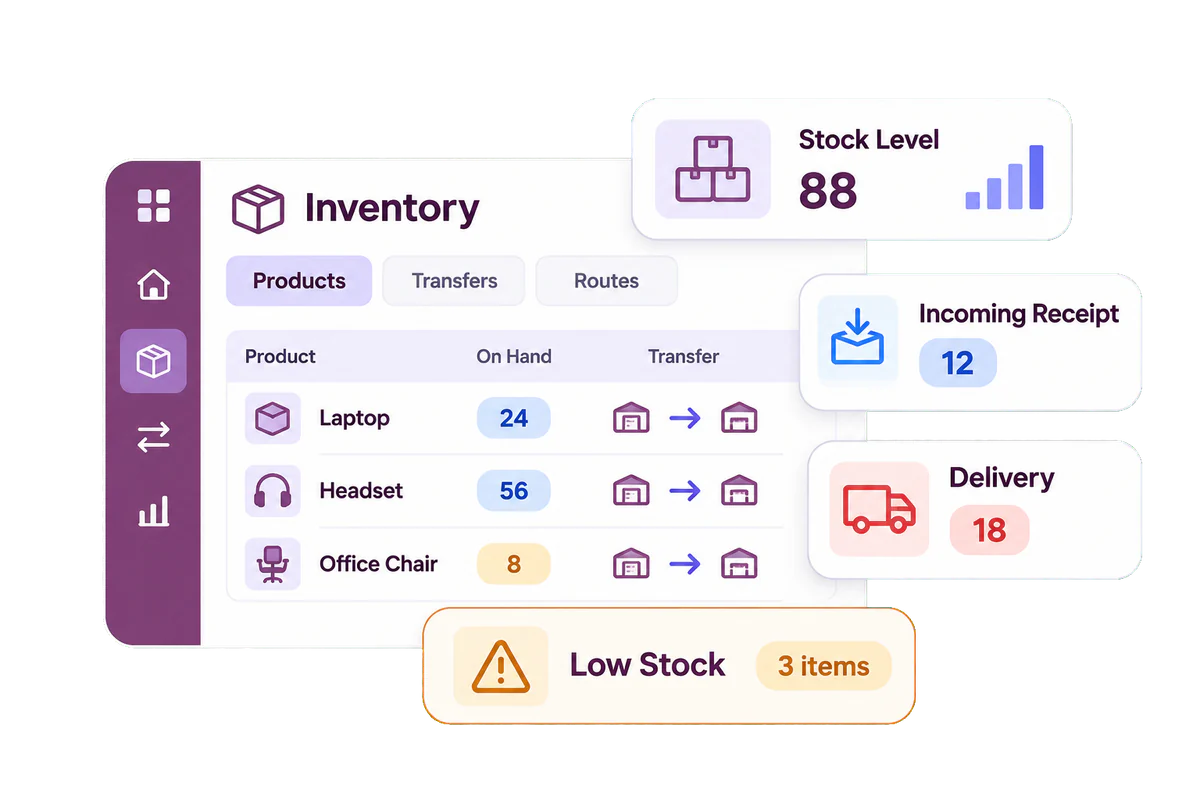
Best fit
Multi-location inventory, wholesale distribution, retail fulfilment, manufacturing materials, and lot- or serial-controlled products.
Control receipts, locations, replenishment, barcode operations, picking, packing, lots, serials, and valuation across warehouses and sales channels.
Odoo Inventory operates on a unique double-entry inventory system where nothing is lost or created—stock simply moves between locations, suppliers, transit lines, and customers with complete mathematical auditability.
Integrated seamlessly with Odoo Sales, Purchase, Manufacturing, and Accounting, your warehouse teams experience a coordinated flow between customer orders, picking routes, vendor receipts, and automated general ledger inventory valuation entries.
Core capabilities
Start with the capabilities that support your critical workflow. Add the rest only when the process requires them.
Manage complex logistics hierarchies across multiple warehouses, zones, aisles, racks, and bins with location-specific rules.
Maintain total inventory auditability with double-entry stock transactions between physical, virtual, and partner locations.
Accelerate receiving, picking, packing, internal transfers, and physical cycle counts with mobile barcode and RFID scanning.
Trigger automated procurement requests or manufacturing orders based on minimum/maximum stock rules and vendor lead times.
Track parts, raw materials, and finished goods end-to-end with serial numbers, batch/lot numbers, and expiration dates.
Configure cross-docking, dropshipping, wave picking, batch picking, and multi-step delivery routes effortlessly.
Core Inventory is available in Community and Enterprise. Barcode and advanced operational capabilities differ by edition and app configuration.
AGSuite verifies the edition, target version, hosting model, localization, dependencies, and custom modules before confirming scope. This prevents licensing assumptions and upgrade conflicts from entering the build.
| Technical factor | Requirement |
|---|---|
| Edition | Core Inventory is available in Community and Enterprise. Barcode and advanced operational capabilities differ by edition and app configuration. |
| Supported target versions | Odoo 18, 19, and 20. Module, localization, and custom-code compatibility must be validated for the target release. |
| Hosting | Odoo Online, Odoo.sh, or on-premise hosting. Custom code and integration requirements determine the suitable option. |
| Dependencies | Accurate products, units, locations, routes, opening quantities, valuation rules, and warehouse responsibilities are required. |
| Common integrations | Barcode devices, carriers, eCommerce, marketplaces, EDI, purchasing, manufacturing, third-party logistics, and accounting. |
| Data readiness | Products, variants, units, locations, lots, serials, expiry dates, opening stock, reorder rules, and inventory values. |
These outcomes depend on process design, data quality, adoption, integration reliability, and the agreed implementation scope.

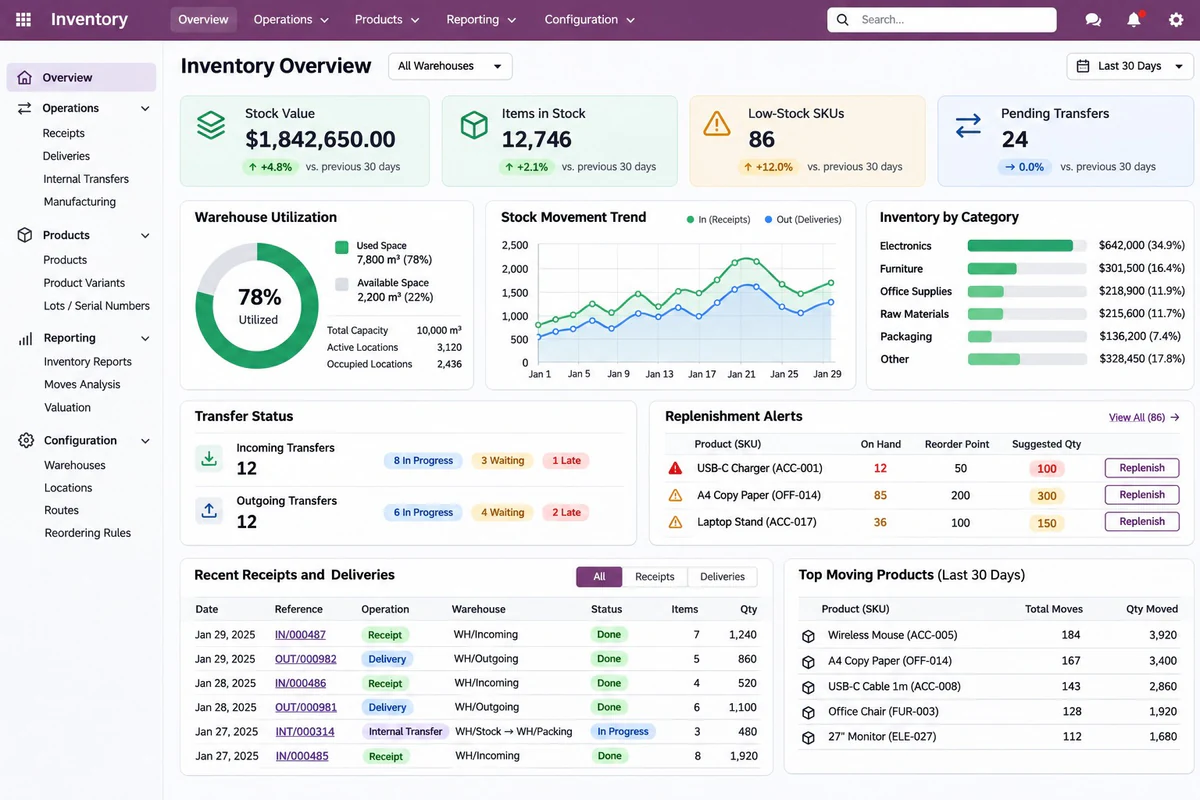
Know exactly what is on hand, incoming, reserved, and in transit across every warehouse, store, and fulfillment center in real time.
AGSuite is an official Odoo Partner. The implementation follows five controlled steps with named business owners, documented acceptance criteria, and production-readiness checks.
Confirm users, workflows, controls, data, integrations, reports, and measurable success criteria.
Define the target process, edition, hosting, configuration, security, migration, and test plan.
Set up the application in controlled iterations and review each workflow with process owners.
Complete data reconciliation, integration testing, role testing, user acceptance, and cutover rehearsal.
Train users, execute cutover, monitor adoption, resolve early issues, and prioritize improvements.
100%
Scoped critical workflows require test evidence
2+
Validation cycles when migration is in scope
5
Controlled implementation stages
Business outcome targets are agreed after baseline measurement. They are not presented as universal software guarantees.
Odoo Inventory is a comprehensive warehouse management system (WMS) built on a double-entry principle. Rather than simply adding or subtracting numbers from a total, stock moves between defined locations (vendors, inventory loss, scrap, production, physical racks, and customers). This ensures every transaction has an origin and destination for a traceable movement history.
Yes. Odoo natively supports multi-company and multi-warehouse structures. You can define distinct fulfillment centers, regional hubs, drop-ship partners, and retail stores, setting up custom push/pull routing rules, internal transfer schedules, and inter-warehouse replenishment workflows.
Absolutely. Odoo has a dedicated mobile barcode scanning application compatible with mobile devices, rugged Android scanners, and Zebra hardware. Warehouse staff can scan barcodes or QR codes for receipts, putaways, batch picks, packings, delivery dispatches, and inventory cycle counts.
Odoo supports Standard Price, Average Cost (AVCO), and FIFO (First-In, First-Out) costing. With automated valuation enabled, warehouse movements immediately generate real-time balancing journal entries in Odoo Accounting. Landed costs such as freight, customs duties, and insurance can also be allocated proportionally across received shipments.
Yes. You can define reordering rules with minimum and maximum thresholds for each product or location. When stock falls below the minimum, Odoo automatically generates a draft Request for Quotation (RFQ) for the preferred vendor or creates a manufacturing order based on product setup.
Yes. Products can be tracked by unique serial numbers or by production lot/batches. Odoo supports expiration dates, removal dates, best-before dates, and alert dates, enforcing FEFO (First-Expired, First-Out) picking logic to minimize spoilage and comply with regulatory requirements.
Odoo provides direct bi-directional connectors for major eCommerce platforms. Sales orders placed online automatically reserve stock in Odoo, and warehouse updates (such as shipment fulfillment and tracking numbers) sync back to the online stores in real time.
A focused warehouse implementation typically takes between 4 to 12 weeks depending on warehouse size, number of locations, barcode scanning scope, eCommerce integrations, custom routing requirements, and staff training. AGSuite delivers a structured, phase-tested roadmap to ensure a controlled cutover for live order fulfilment.

Get a scoped recommendation covering edition, applications, data, integrations, implementation effort, risks, and next steps.