01
Centralized Employee Directory
Maintain a complete digital employee profile for every team member including contract details, job position, reporting manager, skills, certifications, and emergency contacts.
Odoo Employees provides a central workforce directory and connects employee records with recruitment, attendance, leave, expenses, appraisals, payroll, and documents. It is best for HR teams replacing spreadsheets and disconnected employee administration. AGSuite configures organization structures, roles, policies, migration, approvals, integrations, security, reporting, and administrator training as an official Odoo Partner. The final scope reflects your users, controls, data, localization, and deployment model.
Talk to an Odoo expert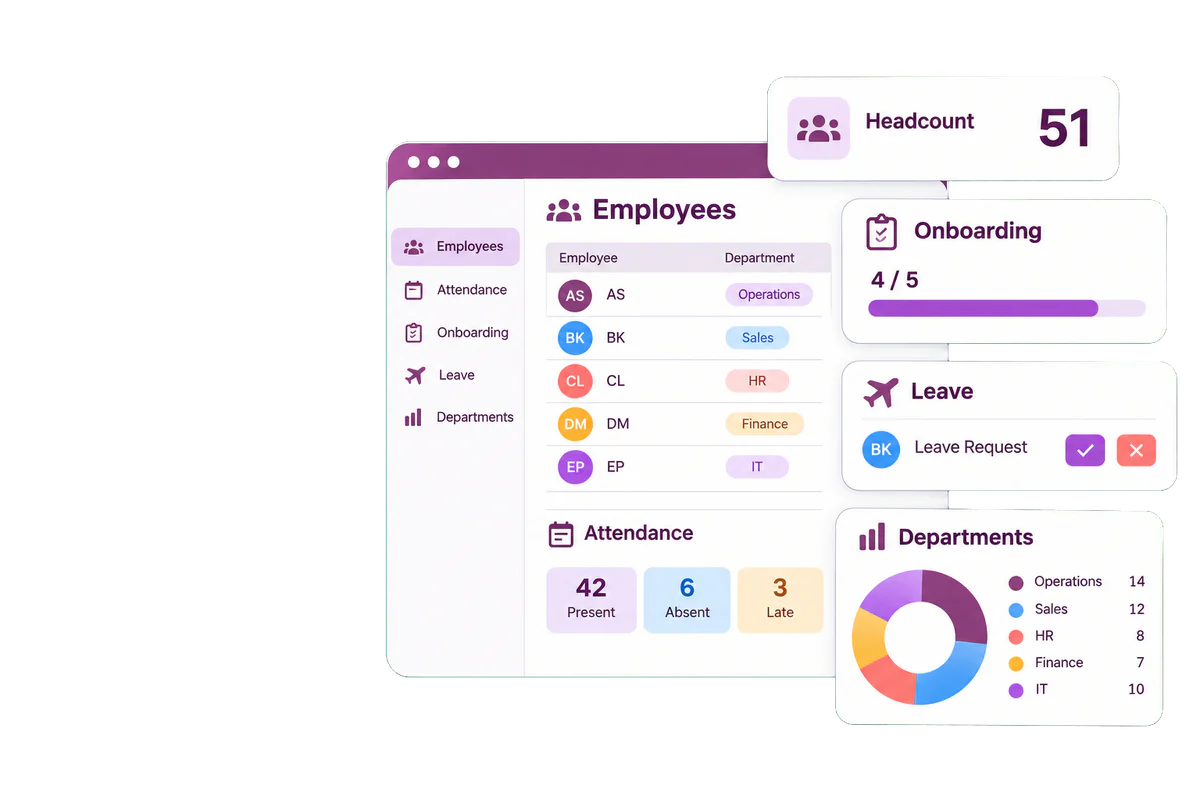
Best fit
Growing HR teams, multi-department organizations, employee self-service, policy-controlled administration, and connected people operations.
Centralize employee records, departments, managers, contracts, documents, skills, and access while connecting recruitment, leave, attendance, expenses, and payroll.
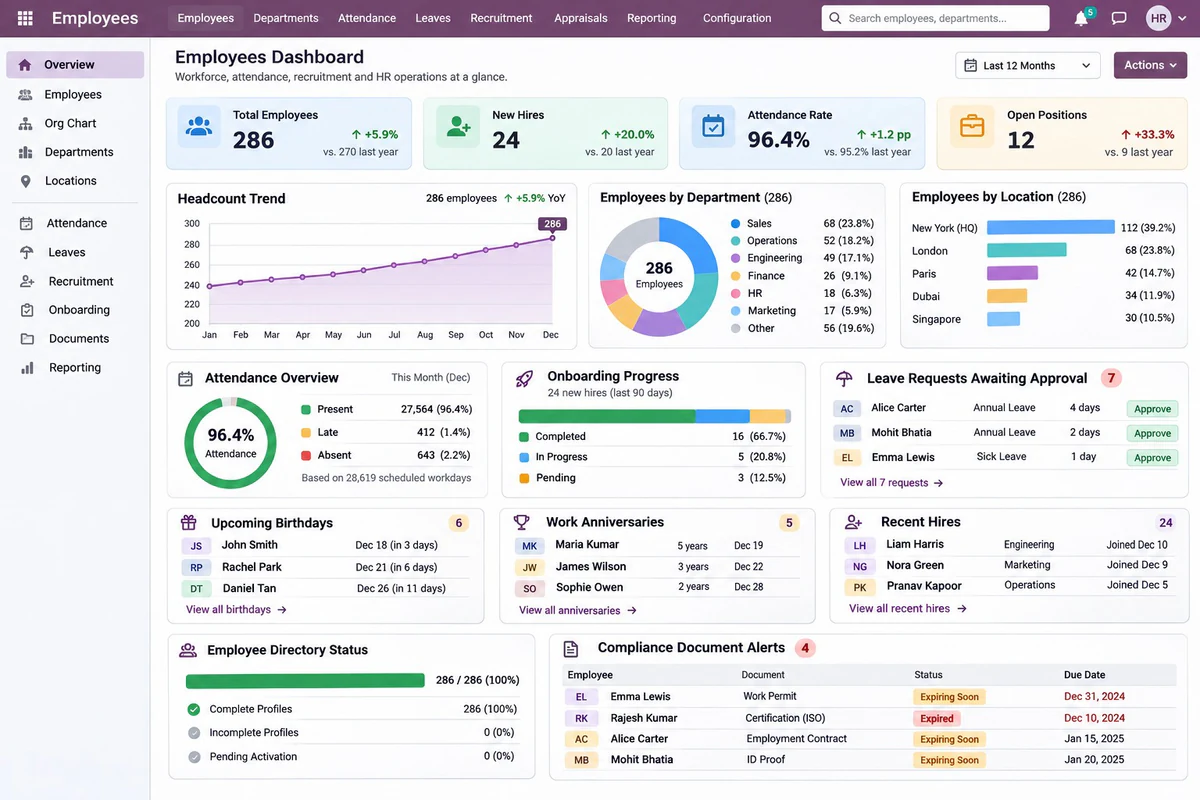
Odoo Employees gives HR teams a centralized platform to manage every stage of the employee journey — recruiting top talent, onboarding new hires, tracking attendance and leaves, processing payroll, and evaluating performance — all from one connected system.
Because Odoo Employees integrates natively with Accounting, Projects, Helpdesk, and Marketing, workforce costs flow directly into financial reports, employee hours link to project profitability, and team capacity is always visible — eliminating the manual reconciliation that comes with disconnected HR software.
Core capabilities
Start with the capabilities that support your critical workflow. Add the rest only when the process requires them.
Maintain a complete digital employee profile for every team member including contract details, job position, reporting manager, skills, certifications, and emergency contacts.
Configure leave types, accrual policies, and approval workflows. Employees submit leave requests from desktop or mobile, managers approve in one click, and balances update automatically.
Track employee check-in and check-out via web, mobile app, or kiosk. Define flexible shift schedules, overtime rules, and tardiness thresholds for accurate attendance reporting.
Employees submit expense claims with receipt photos from the mobile app. Manager approval workflows and direct accounting integration ensure fast, auditable reimbursements.
Manage the full hiring funnel — publish job openings on your website and job boards, track applications by Kanban stage, schedule interviews, and send offer letters from one place.
Store signed employment contracts, NDAs, compliance documents, and certifications securely in the employee record with electronic signature and document expiry tracking.
Core Employees is available in Community and Enterprise. Payroll, Appraisals, Referrals, advanced approvals, and localization depth vary by edition and country.
AGSuite verifies the edition, target version, hosting model, localization, dependencies, and custom modules before confirming scope. This prevents licensing assumptions and upgrade conflicts from entering the build.
| Technical factor | Requirement |
|---|---|
| Edition | Core Employees is available in Community and Enterprise. Payroll, Appraisals, Referrals, advanced approvals, and localization depth vary by edition and country. |
| Supported target versions | Odoo 18, 19, and 20. Module, localization, and custom-code compatibility must be validated for the target release. |
| Hosting | Odoo Online, Odoo.sh, or on-premise hosting. Custom code and integration requirements determine the suitable option. |
| Dependencies | Company structure, departments, roles, managers, contracts, calendars, policies, access rights, privacy requirements, and localization must be defined. |
| Common integrations | Recruitment, Attendance, Time Off, Expenses, Payroll, Appraisals, Planning, Projects, identity providers, and external payroll systems. |
| Data readiness | Employee records, departments, jobs, managers, contracts, calendars, leave balances, documents, skills, and agreed historical records. |
These outcomes depend on process design, data quality, adoption, integration reliability, and the agreed implementation scope.
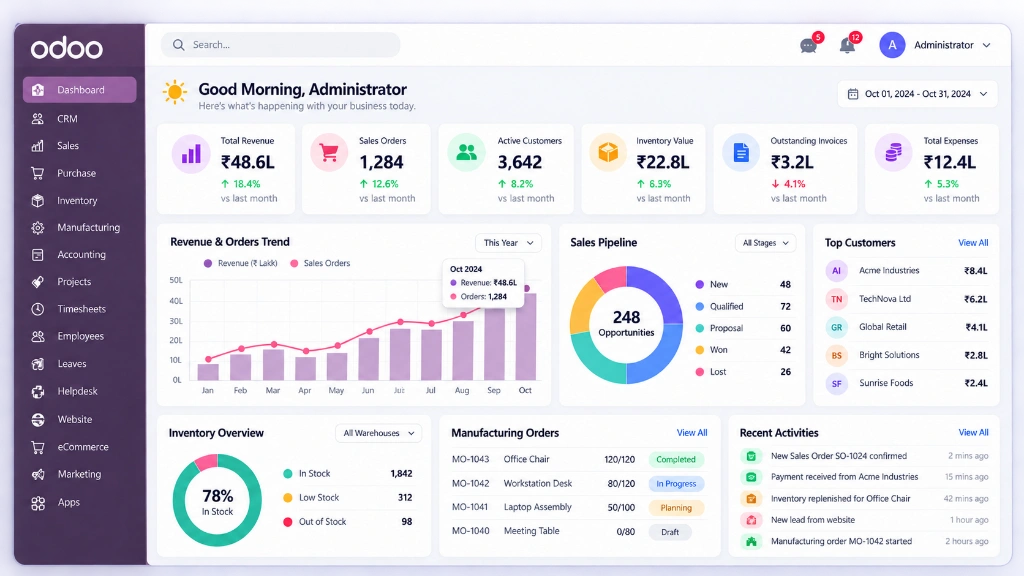
Eliminate scattered spreadsheets and paper records. Odoo Employees stores every team member's profile, contract, attendance, leave balance, and performance data in one secure, searchable system.
AGSuite is an official Odoo Partner. The implementation follows five controlled steps with named business owners, documented acceptance criteria, and production-readiness checks.
Confirm users, workflows, controls, data, integrations, reports, and measurable success criteria.
Define the target process, edition, hosting, configuration, security, migration, and test plan.
Set up the application in controlled iterations and review each workflow with process owners.
Complete data reconciliation, integration testing, role testing, user acceptance, and cutover rehearsal.
Train users, execute cutover, monitor adoption, resolve early issues, and prioritize improvements.
100%
Scoped critical workflows require test evidence
2+
Validation cycles when migration is in scope
5
Controlled implementation stages
Business outcome targets are agreed after baseline measurement. They are not presented as universal software guarantees.
Odoo Employees is a comprehensive HR management module covering the full employee lifecycle — from recruitment and onboarding to contract management, leave and attendance tracking, expense reimbursement, payroll processing, performance appraisals, and offboarding. It is suitable for SMBs and growing enterprises looking to replace disparate HR tools with a single integrated platform.
HR administrators define leave types (annual, sick, unpaid, compensatory) with accrual rules and approval workflows. Employees submit leave requests from the desktop or Odoo mobile app, selecting dates from a calendar that shows team availability. Managers receive approval notifications, and upon approval, leave balances update automatically and are reflected in payroll calculations.
Yes. Employees can check in and out via the Odoo web interface, the mobile app, or a physical kiosk device. Work schedules define expected hours, and the system tracks real attendance against scheduled shifts — generating overtime, absence, and tardiness reports automatically for HR review.
Yes. Odoo includes a payroll module where HR teams define salary structures with configurable basic pay, allowances, statutory deductions, and commission calculations. Payroll runs generate individual payslips for each employee and create the corresponding accounting journal entries — ensuring payroll and finance remain perfectly synchronized.
Odoo Recruitment provides a Kanban-based applicant tracking system (ATS). Job positions can be published to your Odoo website, LinkedIn, and other job boards. Applications move through configurable pipeline stages — Screening, Interview, Offer, Hired — with automated email templates at each stage, integrated interview scheduling, and offer letter generation.
Yes. The Odoo mobile app allows employees to photograph receipts, categorize expenses, and submit reimbursement claims in under a minute. Managers receive push notifications to approve claims, and upon approval, the expense amount is automatically reconciled in Odoo Accounting and queued for the next payroll reimbursement cycle.
Yes. Odoo Appraisals enables HR teams to schedule periodic review cycles, assign structured appraisal templates with rating scales and goal sections, collect peer and manager feedback, and record final performance scores. Results feed into compensation review workflows and development plan assignments.
A standard Odoo Employees implementation with AGSuite typically takes 3 to 7 weeks, covering employee data migration, leave policy configuration, contract template setup, payroll salary structure definition, and manager training. Recruitment module setup and payroll go-live may add additional time depending on complexity.

Get a scoped recommendation covering edition, applications, data, integrations, implementation effort, risks, and next steps.