01
Drag-and-Drop Online Store Builder
Design and customize your storefront, product pages, and checkout flow visually using Odoo's no-code block editor with professionally designed eCommerce themes.
Odoo eCommerce connects storefront content, products, variants, pricing, checkout, payments, orders, inventory, fulfilment, customer accounts, and accounting. It is best for B2C or B2B sellers that want commerce data in the same platform as operations. AGSuite configures catalog, experience, integrations, migration, SEO, payments, shipping, testing, and training as an official Odoo Partner. The final scope reflects your users, controls, data, localization, and deployment model.
Talk to an Odoo expert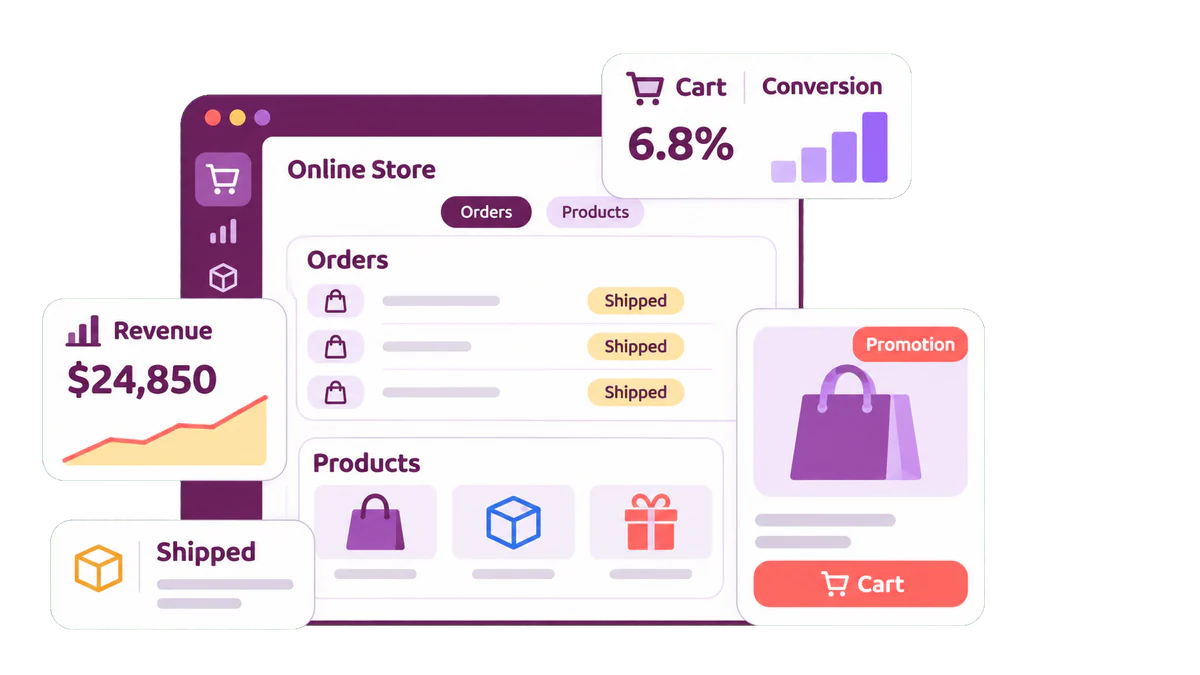
Best fit
B2C stores, B2B portals, product catalogs, omnichannel sellers, configurable products, and businesses needing connected fulfilment.
Connect storefront content, products, prices, checkout, payments, inventory, shipping, customer accounts, orders, returns, and accounting.
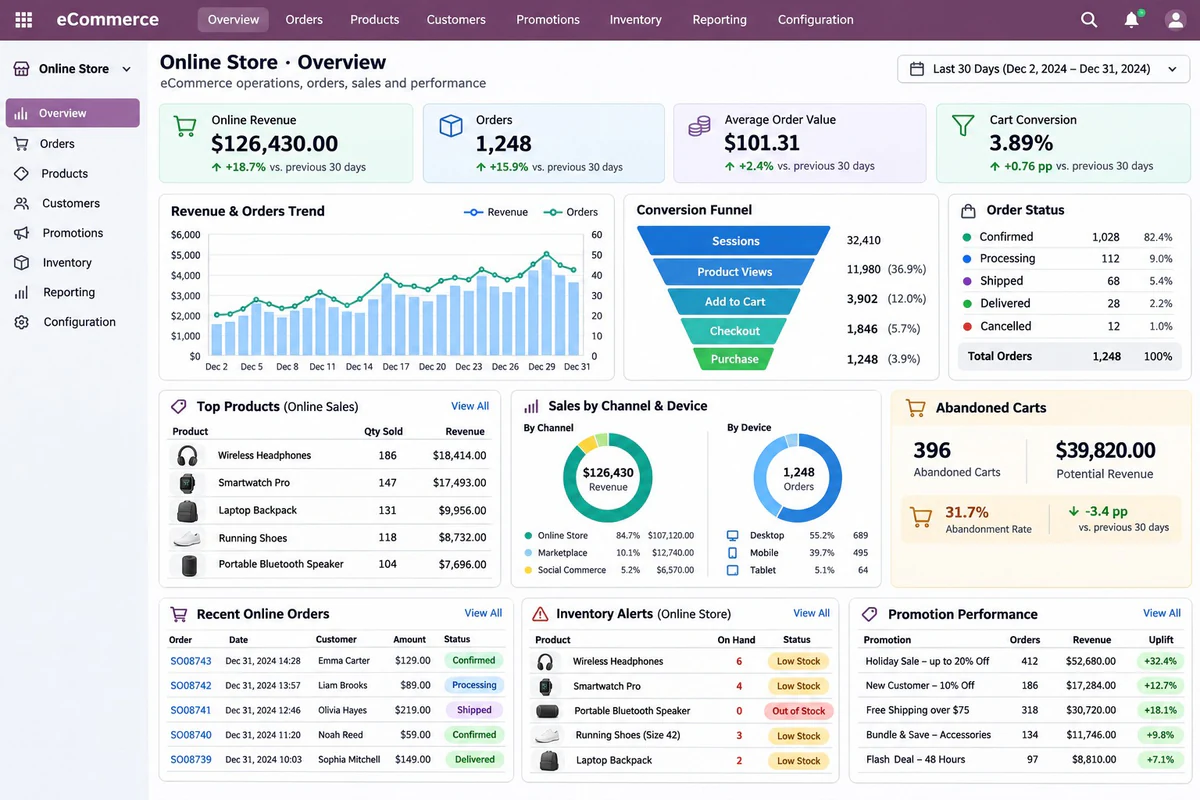
Odoo eCommerce gives businesses a powerful online store that is natively connected to inventory, accounting, CRM, and marketing — eliminating the disconnected plugin stacks that slow down Shopify and WooCommerce-based operations.
Whether you sell B2C to individual consumers or run a B2B wholesale portal with company-specific pricing and credit terms, Odoo eCommerce handles both from the same backend — giving your team a single system to manage products, orders, payments, fulfillment, and customer communication.
Core capabilities
Start with the capabilities that support your critical workflow. Add the rest only when the process requires them.
Design and customize your storefront, product pages, and checkout flow visually using Odoo's no-code block editor with professionally designed eCommerce themes.
Manage unlimited products with multiple variants (size, color, material), price lists, product configurators, and downloadable digital product delivery.
Serve international customers with automatic currency conversion, geo-targeted pricelists, customer segment pricing, and promotional discount rules.
Accept payments via Stripe, PayPal, Razorpay, Authorize.net, and other providers. Manage partial payments, deposits, and installment billing directly from the order.
Product stock levels on the website update automatically as warehouse stock changes — preventing overselling, backorder confusion, and manual catalog corrections.
Automatically identify and email customers who leave products in their cart without completing checkout, with personalized recovery offers to drive conversion.
eCommerce is available in Community and Enterprise. Advanced apps, hosting, support, Studio, and some payment or delivery options vary by edition.
AGSuite verifies the edition, target version, hosting model, localization, dependencies, and custom modules before confirming scope. This prevents licensing assumptions and upgrade conflicts from entering the build.
| Technical factor | Requirement |
|---|---|
| Edition | eCommerce is available in Community and Enterprise. Advanced apps, hosting, support, Studio, and some payment or delivery options vary by edition. |
| Supported target versions | Odoo 18, 19, and 20. Module, localization, and custom-code compatibility must be validated for the target release. |
| Hosting | Odoo Online, Odoo.sh, or on-premise hosting. Traffic, custom code, integrations, deployment controls, and performance needs guide selection. |
| Dependencies | Products, variants, categories, prices, taxes, inventory, payments, shipping, returns, customer terms, domains, and content are required. |
| Common integrations | Payment gateways, carriers, tax services, marketplaces, analytics, marketing, warehouses, product feeds, and external fulfilment systems. |
| Data readiness | Catalog, variants, media, prices, stock, customer accounts, orders, tax rules, shipping rules, redirects, and SEO metadata. |
These outcomes depend on process design, data quality, adoption, integration reliability, and the agreed implementation scope.
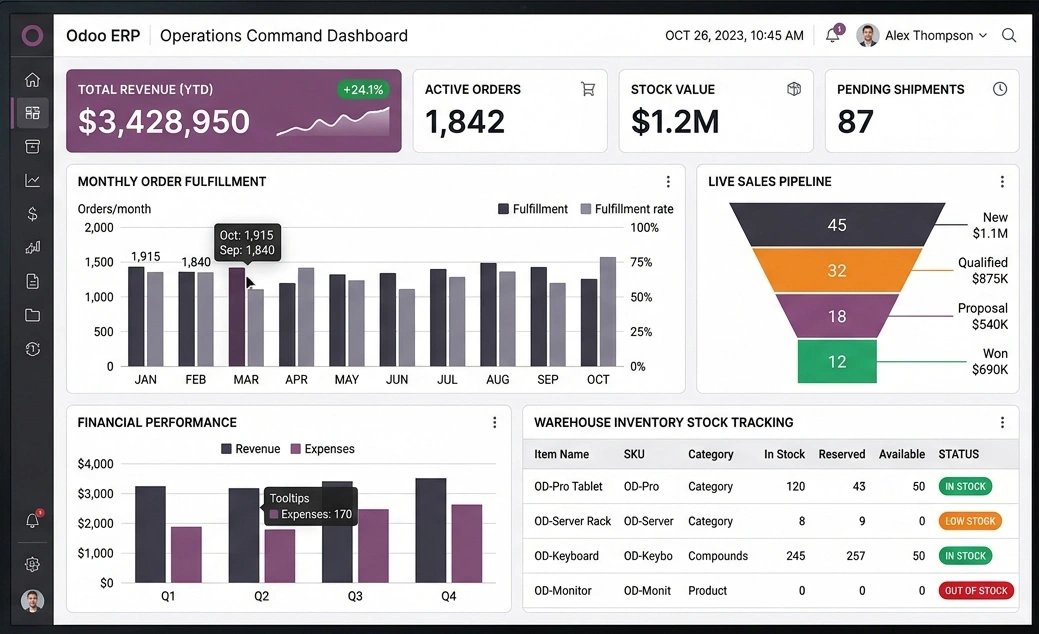
Because Odoo eCommerce shares the same inventory database as your warehouse operations, stock levels on your website are always accurate — eliminating overselling, manual syncing, and customer complaints.
AGSuite is an official Odoo Partner. The implementation follows five controlled steps with named business owners, documented acceptance criteria, and production-readiness checks.
Confirm users, workflows, controls, data, integrations, reports, and measurable success criteria.
Define the target process, edition, hosting, configuration, security, migration, and test plan.
Set up the application in controlled iterations and review each workflow with process owners.
Complete data reconciliation, integration testing, role testing, user acceptance, and cutover rehearsal.
Train users, execute cutover, monitor adoption, resolve early issues, and prioritize improvements.
100%
Scoped critical workflows require test evidence
2+
Validation cycles when migration is in scope
5
Controlled implementation stages
Business outcome targets are agreed after baseline measurement. They are not presented as universal software guarantees.
Odoo eCommerce is a fully integrated online store module built natively into the Odoo platform. Unlike Shopify or WooCommerce — which require third-party plugins or custom integrations to connect to your ERP, inventory, and accounting — Odoo eCommerce shares the same database as your warehouse, finance, CRM, and marketing modules. This eliminates data silos, manual syncing, and plugin management.
Odoo eCommerce and Odoo Inventory share a live database. When a customer places an order online, stock is reserved immediately. When a delivery is completed in the warehouse, the product availability on the website updates automatically. You can also display multi-warehouse availability and configure backorder and out-of-stock messaging per product.
Odoo supports a wide range of payment providers including Stripe, PayPal, Razorpay, Authorize.net, Adyen, Mollie, and local payment gateways depending on your region. Multiple payment acquirers can be active simultaneously, and customers can save cards for future purchases on their portal account.
Yes. Odoo supports both B2B and B2C customers from the same platform. B2B buyers can be assigned to dedicated pricelists with volume discounts, minimum order quantities, payment terms, and quote-request workflows. B2C customers experience a standard consumer checkout. Each segment is fully configurable without needing separate stores.
Yes. Odoo includes a promotions and coupon engine that supports percentage discounts, fixed amount reductions, free product giveaways, minimum order conditions, free shipping thresholds, and customer loyalty points. Promotions can be auto-applied or require a coupon code at checkout.
When a logged-in customer adds items to their cart and leaves without completing checkout, Odoo records the abandoned session. Automated email sequences can be configured to send recovery messages at defined intervals — with personalized product images, a direct cart link, and optional discount incentives to encourage completion.
Yes. Each customer has access to a self-service portal on your Odoo website where they can view order status and delivery tracking, download PDF invoices and receipts, manage active subscriptions, initiate return or exchange requests, and access their purchase history — all without contacting your support team.
A standard Odoo eCommerce rollout with AGSuite takes 4 to 8 weeks depending on catalog size, custom theme requirements, payment gateway configuration, shipping integrations, and B2B portal complexity. We handle full storefront setup, product import, payment testing, and team training before go-live.

Get a scoped recommendation covering edition, applications, data, integrations, implementation effort, risks, and next steps.